
Pure, unmodified phenol formaldehyde (PF) resin is an electrical insulator, with volume resistivity typically in the range of 1010 to 1016 ohm-centimeter depending on grade and test conditions [1][2][3]. PF resin can be made conductive or static-dissipative by adding conductive fillers such as carbon black, graphite, carbon fiber, or metal-plated particles [4][5]. The resin itself does not become intrinsically conductive through formulation alone. For pure insulating PF, ASTM D257-14(2021)e1 is the standard test method; for moderately conductive PF composites, ASTM D4496 is the appropriate method [6][7].
1. What Is Phenol Formaldehyde Resin?
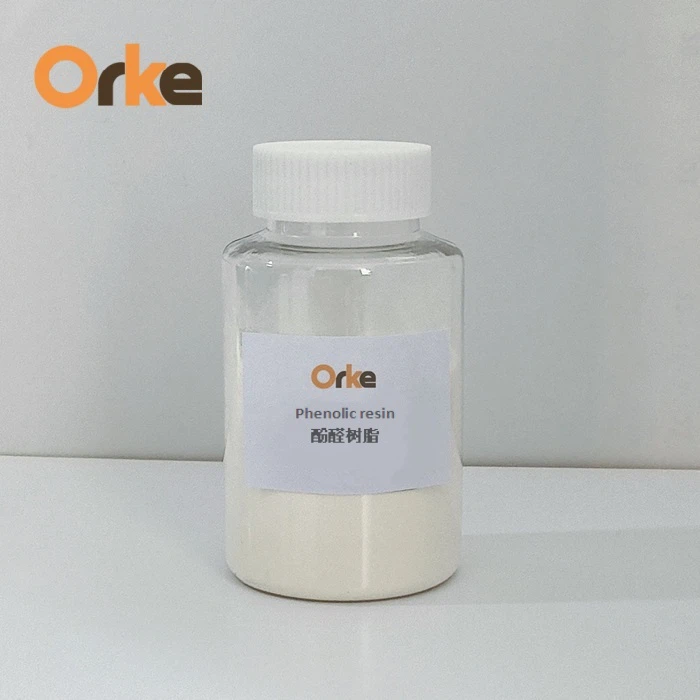
Phenol formaldehyde resin (PF) is a thermosetting polymer produced by the reaction of phenol with formaldehyde [8]. Once cured, it forms a rigid, cross-linked network that does not melt on heating [8][9]. PF is used in electrical components, friction materials, composites, and oilfield equipment [8][10]. A dedicated Phenol Formaldehyde Resin grade is specified for electrical, friction, composite, and oilfield applications [8][10].
2. Is Pure PF Resin Conductive?
No. Cured, unmodified PF resin is an electrical insulator. Typical volume resistivity data from commercial grades and standards:
| Material / Grade | Volume Resistivity | Test Method / Standard | Reference |
|---|---|---|---|
| AG-4V phenolic molding compound (GOST 20437-89) | Specification: 1010 ohm-m minimum (i.e., 1012 ohm-cm); typical measured: 4.5 times 1011 ohm-m (4.5 times 1013 ohm-cm) | GOST 20437-89 | [1] |
| Plenco 06343 (transfer grade, two-stage phenolic) | 5.1 times 1012 ohm-cm (typical) | ASTM D257 | [2] |
| PF matrix (before conductive filler addition) | 1.62 times 1016 ohm-cm | Internal measurement per published study | [3] |
| PF resin (general industry range) | 1012 to 1014 ohm-cm (typical) | Industry survey | [11] |
Note: resistivity depends on grade, filler system, cure degree, temperature, and humidity. Always confirm with supplier TDS. Units as reported: 1 ohm-m equals 100 ohm-cm.
3. How PF Resin Can Be Made Conductive
PF resin becomes conductive only through the addition of conductive fillers that form a percolating network within the insulating polymer matrix [4][5]. Common approaches:
| Filler System | Typical Loading | Result | Reference |
|---|---|---|---|
| Carbon black / graphite | 5–20 wt.% | Static dissipative to semi-conductive; percolation behavior typically observed between 14% and 24% loading | [4] |
| Carbon fiber | 5–15 wt.% | Conductive composite | [4] |
| Silver-plated graphite nanosheet (Ag-plated NanoG) | Grade-specific (per published study) | Volume resistivity drops from 1.62 times 1016 ohm-cm (neat PF) to conductive range | [3] |
| Graphene + ionic liquid (C10[VImBr]2) | 15 wt.% graphene + 5 wt.% IL | Conductivity increases from 2.3 times 10-10 to 4.14 times 10-3 S/m (15 wt% graphene), reaching 0.145 S/m with the addition of 5 wt.% ionic liquid | [5] |
Key point: the PF resin itself remains insulating. Conductivity is a property of the composite, not the resin.
4. What This Article Does NOT Claim
- No claim that PF resin is intrinsically conductive. Pure cured PF is an insulator [1][2][8].
- No claim that "tweaking the resin" alone produces conductivity. Conductive fillers are required [3][4][5].
- No claim that thermal degradation under normal service conditions makes PF conductive. Carbonization at extreme temperatures (above 300 degrees C, prolonged) can alter electrical properties, but this is degradation, not a designed property.
- No claim that a single resistivity value characterizes all PF grades. Resistivity varies by grade, filler system, cure degree, and test conditions [1][2][3].
- No claim that ASTM D257 is suitable for moderately conductive PF composites. For moderately conductive materials, ASTM D4496 is the appropriate method [6][7].
5. Application Considerations
| Application | Requirement | PF Grade Type |
|---|---|---|
| Electrical insulators / switchgear | High volume resistivity | Standard electrical grade [2] |
| Static-dissipative composites | Surface resistivity 106 to 109 ohm | PF + conductive filler [4] |
| Oilfield downhole tools | Insulation + thermal stability | Phenolic Resin For Oil Fields (insulating) [10] |
| Friction materials | Insulation (avoid sensor interference) | Phenolic Resin For Friction Materials [10] |
| EMI shielding composites | Conductivity for shielding effectiveness | PF + graphene/ionic liquid (up to 28.64 dB documented) [5] |
6. Quality Parameters to Request
| Parameter | Method | What It Tells You |
|---|---|---|
| Volume resistivity (insulating PF) | ASTM D257-14(2021)e1 | Insulation capability for high-resistivity grades [6] |
| Volume / surface resistivity (moderately conductive PF composites) | ASTM D4496 | Conductivity for static-dissipative and semi-conductive grades [7] |
| Surface resistivity | ASTM D257 (or D4496 for lower-resistivity materials) | Static dissipation / tracking risk [6] |
| Dielectric strength | ASTM D149 | Breakdown resistance [2] |
| Filler type and loading (if conductive) | Supplier TDS | Conductivity mechanism and percolation threshold [3][4] |
| EMI shielding effectiveness (if applicable) | Per published methods | Shielding performance for graphene/IL-modified PF [5] |
7. Conclusion
As the preceding sections show, pure unmodified phenol formaldehyde resin is an electrical insulator with volume resistivity typically in the 1010 to 1016 ohm-cm range, depending on grade, filler system, cure degree, and test conditions. Commercial PF grades such as AG-4V (per GOST 20437-89) and Plenco 06343 (per ASTM D257) confirm this insulation behavior. PF resin becomes conductive only through the addition of conductive fillers - carbon black, graphite, carbon fiber, silver-plated graphite nanosheet, or graphene with ionic liquid - that form a percolating network within the insulating matrix. Published studies document conductivity improvements of up to nine orders of magnitude (2.3 times 10-10 S/m to 0.145 S/m with graphene plus ionic liquid) and EMI shielding effectiveness reaching 28.64 dB [5]. For insulating PF, ASTM D257-14(2021)e1 is the standard test method; for moderately conductive PF composites, ASTM D4496 is the appropriate alternative. Every value in this article is a typical published range or standard requirement; selection must be validated against supplier TDS, batch COA, and a structured trial on the actual formulation.
8. Next Step
If you are evaluating Phenol Formaldehyde Resin for an application requiring insulation or controlled conductivity, send us:
- Target resistivity range (insulating, static-dissipative, or conductive)
- Application (electrical insulator, ESD composite, EMI shielding, oilfield, friction)
- Filler type preference (carbon black, graphite, carbon fiber, Ag-plated NanoG, graphene, or ionic liquid)
- Processing method
- Required documentation (TDS, COA, resistivity data, EMI shielding data if applicable)
We will recommend a suitable grade or filler system for your evaluation.
Request Phenol Formaldehyde Resin TDS and Resistivity Data →
References
- Region-Electro JSC. Moulding Material AG-4V (Thermosetting Plastic Materials for Pressing Dielectric Details), per GOST 20437-89. Kazan, Russia. [Specification: specific volume resistance 1010 ohm-m minimum (1012 ohm-cm); typical measured: 4.5 times 1011 ohm-m (4.5 times 1013 ohm-cm).]
- Plenco. Plenco 06343 - Transfer Molded Two-Stage Phenolic Molding Compound, Technical Datasheet. Plastics Engineering Company, Sheboygan, WI. [Volume resistivity: 5.1 times 1012 ohm-cm per ASTM D257; dielectric strength 18.3 kV/mm per ASTM D149; dissipation factor 0.035 at 1 MHz.]
- Liu, N.; Qi, X.; et al. "Preparation and characterization of phenol formaldehyde/Ag/graphite nanosheet composites." Polymer, 2011 (cited 34+). [Documents conductive PF/Ag-plated graphite nanosheet (NanoG) composites; PF matrix resistivity 1.62 times 1016 ohm-cm before filler addition.]
- Xanthos, M. (Ed.). Functional Fillers for Plastics. Wiley-VCH, Weinheim, 2010. ISBN 978-3-527-31054-8. [Comprehensive overview of mineral and organic fillers for plastics; includes percolation behavior and carbon filler systems.]
- Li, Y.-C.; Lee, S.-Y.; Wang, H.; Jin, F.-L.; Park, S.-J. "Enhanced Electrical Properties and Impact Strength of Phenolic Formaldehyde Resin Using Silanized Graphene and Ionic Liquid." ACS Omega, December 18, 2023. DOI: 10.1021/acsomega.3c05198. [Documents conductivity increase from 2.3 times 10-10 to 4.14 times 10-3 S/m (15 wt.% graphene), reaching 0.145 S/m with 5 wt.% C10[VImBr]2 ionic liquid; EMI shielding 4.70 to 28.64 dB; impact strength 0.59 to 1.53 kJ/m2.]
- ASTM International. ASTM D257-14(2021)e1 - Standard Test Methods for DC Resistance or Conductance of Insulating Materials. West Conshohocken, PA: ASTM, published March 1, 2021. [Covers DC insulation resistance, volume resistance, and surface resistance; not suitable for moderately conductive materials.]
- ASTM International. ASTM D4496 - Standard Test Method for DC Resistance or Conductance of Moderately Conductive Materials. West Conshohocken, PA: ASTM. [Applicable for moderately conductive materials, per ASTM D257-14(2021)e1 scope note.]
- Knop, A.; Pilato, L. A. Phenolic Resins: Chemistry, Applications and Performance. Springer, Berlin, 1985. ISBN 3-540-15039-0 (reprinted 2013).
- Ratna, D. Handbook of Thermoset Resins. iSmithers Rapra Publishing, Shawbury, 2009.
- Phenolic Resin Applications Series (Supplementary Industry Background). Phenolic Resin For Oil Fields, Phenolic Resin For Friction Materials, Phenolic Resin For Composite Materials, Electronic Grade Phenolic Resin. [Cross-references to dedicated application pages.]
- Income Pultrusion. The Complete Phenolic Resin Guide: Everything Engineers Need to Know (industry technical background; PF volume resistivity 1012 to 1014 ohm-cm; dielectric strength 15–25 kV/mm). [Industry background.]