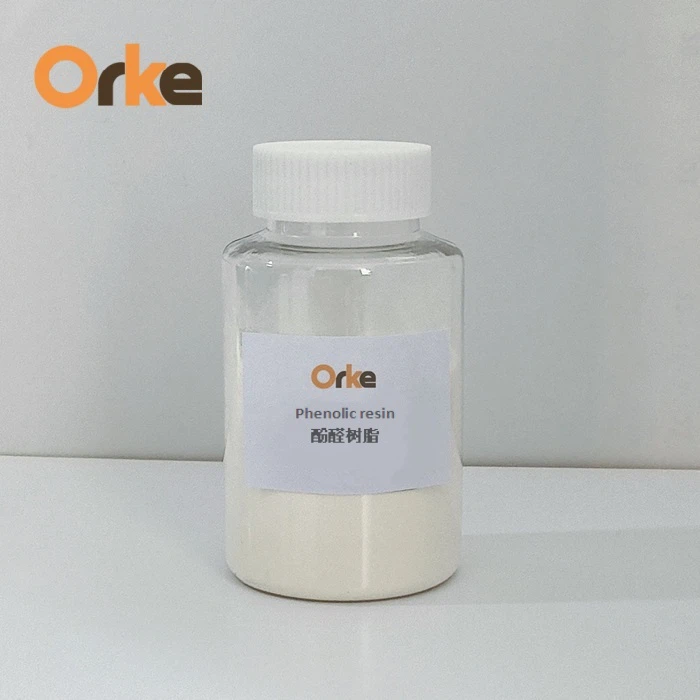

When a PCB runs continuously in a server cabinet for three years, cycling between −40 °C and 85 °C day after day - will it delaminate? When an RF board in a 5G base station goes through two full winters outdoors, will signal attenuation quietly erode coverage radius? The answer often depends not on copper thickness or chip process node, but on an insulating layer nearly invisible to the eye: Electronic Grade Phenolic Resin.
Electronic grade phenolic resin is a deeply purified resole-type phenolic resin; what distinguishes it from ordinary industrial phenolic resin is not the word "resin" but the impurity-control scale that "electronic grade" represents. In ordinary phenolic resins, residual free phenol, metal ions, and halogens become sources of ionic contamination in electronic encapsulation, inducing electrochemical migration on chip surfaces. Electronic-grade products typically specify free phenol below 200 ppm, metal impurities at the ppm-to-ppb level, and total halogens below 1 ppm [2]. [Supplier-documented specification; not a regulatory threshold. Confirm against the specific grade's COA.] This purity is not "a bit better" - it is the entry threshold that determines whether a resin can enter the semiconductor encapsulation and high-end copper-clad-laminate supply chain.
1. Thermomechanical Reliability: The Most Fundamental and Most Undervalued Value
After cure, resole-type phenolic resin typically shows a glass transition temperature (Tg) above 150 °C, with some formulation systems reaching 170 °C or higher [1][2]. [Supplier-documented indicative ranges; grade-specific DMA data govern.] This is sufficient to withstand typical lead-free reflow peak temperatures of 245–260 °C [1]. More importantly, resole-type phenolic resin requires no external hardener (such as hexamethylenetetramine) and self-crosslinks upon heating, allowing it to embed seamlessly into the continuous production lines of electronics factories [3]. For buyers, this means fewer compounding steps, shorter cure-wait times, and more predictable batch consistency - in the production rhythm of copper-clad laminates or encapsulation molding compounds, the width of the process window converts directly into yield and lead time.
2. CTE Matching: An Unavoidable Engineering Reality in Semiconductor Encapsulation
The coefficient of thermal expansion (CTE) of silicon is approximately 2.6 ppm/°C (standard materials-property reference value), while most organic resin systems - as neat-resin values - typically fall in the 50–80 ppm/°C band, with filled systems substantially lower depending on filler loading. The value of electronic grade phenolic resin is not that the neat resin itself "has a CTE equal to silicon," but that it acts as a curative or matrix component and, in synergy with silica (silicon-dioxide powder) filler systems, constrains the overall thermal-expansion behavior of the encapsulant within the range the chip can tolerate, suppressing interfacial cracking and solder-joint fatigue during temperature cycling. Commercial phenolic resins for electronic encapsulation have demonstrated this formulation flexibility - their CTE can be designed within a formulation-dependent band, with indicative published values on the order of ~66 ppm/°C depending on filler system and crosslink density [4]. [Formulation-dependent indicative value; bibliographic details of the original publication to be confirmed. Verify against the specific formulation's TMA data.]
3. High-Frequency Scenarios: Where the Contradiction Shifts from Thermomechanical to Dielectric
Standard phenolic resin shows a dielectric loss (Df) of roughly 0.02 near 1 GHz; for signal transmission in the 5G mid-band (1–6 GHz), this loss level significantly shortens effective transmission distance. Electronic grade phenolic resin, after molecular-structure modification and deep impurity removal, can reach Df on the order of 0.003, while maintaining batch stability of dielectric constant (Dk) across the 1–6 GHz range [5]. [Supplier-documented indicative values; confirm against the specific grade's measured Dk/Df sweep data.] This does not mean phenolic resin displaces PTFE or LCP in the millimeter-wave band; but in sub-6 GHz base-station RF boards, Wi-Fi 6E routers, and industrial high-frequency sensors, it offers typically lower cost than fluoropolymers with sufficiently low loss and far higher heat resistance than thermoplastics. For procurement teams seeking "adequate performance, controllable cost, stable supply" substrate materials for 5G small cells or high-speed servers, this is an option worth calculating seriously.
4. Beyond Encapsulation: The Capability Boundary of a Material Platform
Stepping out of the encapsulation context, phenolic resin as a material platform has a much wider capability boundary. The same resole chemistry, after formulation adjustment, serves entirely different industrial scenarios: in oilfield cementing and high-temperature sealing, Phenolic Resin For Oil Fields supports structural integrity in deep-well environments through heat and chemical resistance; in friction materials, Phenolic Resin For Friction Materials serves as the matrix binder for high-performance brake pads and clutch facings, carrying coupled thermal-mechanical loads; in composites, Phenolic Resin For Composite Materials acts as the matrix for carbon or glass fibers, balancing flame retardance, stiffness, and cost; even in pyrotechnic compositions, Phenolic Resin For Fireworks serves as a binder controlling burning rate and mechanical strength. These applications share the same underlying chemistry but impose completely different requirements on purity, cure speed, and morphology [2][3] - which also means that a resin supplier with molecular-design and purification capability has a technical depth far beyond a single grade.
~66 ppm/°C band, formulation-dependent [4]| Indicator | Electronic-Grade Requirement | How Industrial Grades Differ | Failure Manifestation if Misapplied |
|---|---|---|---|
| Free phenol | Typically <200 ppm (supplier spec) [2] | No targeted limit | Ionic contamination → electrochemical migration → field failure |
| Metal impurities | ppm-to-ppb level [2] | No targeted limit | Mobile-ion drift → leakage current, threshold shift |
| Total halogens | <1 ppm [2] | No targeted limit | Corrosion risk under bias-temperature-bias stress |
| Tg / reflow tolerance | Resole Tg >150 °C, some grades 170 °C+ [1][2]; withstands 245–260 °C lead-free reflow [1] | Tg lower or batch-variable | Delamination under reflow / long-term thermal cycling |
| CTE (via filler synergy) | Neat-resin CTE 50–80 ppm/°C; poor filler coordination | Interfacial cracking, solder-joint fatigue under temp cycling | |
| Df @ 1 GHz | Modified electronic grade: ~0.003 [5] | Standard phenolic: ~0.02 | Excess signal loss in sub-6 GHz RF substrates |
5. Where the Procurement Decision Lands
Back to the procurement level: when evaluating an electronic grade phenolic resin, the questions worth asking go beyond "what is the Tg." Whether the actual free-phenol level is stably below 200 ppm; whether metal ions reach the ppb level; whether the inter-batch molecular-weight distribution is narrow enough to guarantee coating uniformity. [All three questions are supplier-specification territory; ask for COA traceability across batches.] These indicators never appear on the spec sheet of the final electronic product, but they determine whether your production line still stalls for parameter adjustment over the same incoming-lot cure-behavior fluctuation six months later.
Phenolic Resin For Oil Fields, Phenolic Resin For Fireworks, Phenolic Resin For Friction Materials, Phenolic Resin For Composite Materials - these are different faces of the same material platform; Electronic Grade Phenolic Resin is the end of that platform where purity and reliability requirements are most severe. If you are looking for a resin that stands up to data traceability and production-line verification for your next encapsulation project, copper-clad laminate grade, or high-frequency substrate scheme, welcome to bring your Tg target, Df budget, and purity specification - we can judge together, at the molecular-weight and cure-kinetics level, which technical route truly matches your application boundary.
What This Article Does NOT Claim
- This article does not claim that electronic grade phenolic resin displaces PTFE or LCP in the millimeter-wave band. The sub-6 GHz positioning described here is the honest boundary of this material class [5].
- This article does not claim that Df ≈ 0.003 applies to all modified electronic-grade phenolic grades. Dielectric performance must be verified per grade with actual Dk/Df sweep data [5].
- This article does not claim that the purity specifications (free phenol <200 ppm, metals ppb, halogens <1 ppm) are regulatory thresholds. They are supplier-documented entry specifications; REACH/RoHS compliance is a separate conformance statement [2].
- This article does not claim that the CTE value (~66 ppm/°C) transfers across filler systems. CTE depends on filler loading, particle size, and crosslink density; formulation-specific TMA data govern [4].
- This article does not provide specific formulation ratios or curing process parameters. These must be developed and validated by the manufacturer for the specific application.
References
- Orke Chemical. Electronic Grade Phenolic Resin: Technical Parameters and Applications. Company technical documentation. [Supplier-documented; not independently verified. Tg >150 °C, some grades 170 °C or higher; withstands typical lead-free reflow peak temperatures of 245–260 °C. Supplier-specification ranges, not regulatory thresholds.]
- Jinan Shengquan Group Co., Ltd. Technical Description of Electronic Grade Phenolic Resin Products. Company technical documentation. [Supplier-documented purity specifications: residual phenol <200 ppm, metal elements at ppb level, total halogens <1 ppm, REACH/RoHS conformance stated. These are supplier entry specifications, not regulatory thresholds. In line with the supplier-documented values cited across this site's electronic-grade articles.]
- Milewski, B., Antosz, R., Skowronek, M., & Laska, J. "Interaction of hexamethylenetetramine with phenol-formaldehyde resin during simultaneous curing of novolac and resole." ACS Omega. [Peer-reviewed study of simultaneous novolac/resole curing: demonstrates that resole resins self-crosslink upon heating while novolac requires hexamethylenetetramine; HMTA volatilizes and reacts progressively across a 90–200 °C window, with dominant crosslinking around 150–170 °C. Volume, pages, and DOI to be confirmed against the original publication. Same anchor as cited in this site's novolac-vs-resole article.]
- "Structure and Properties of Commercial Phenolic Resins for Electronic Packaging." ACS Applied Polymer Materials. [Peer-reviewed study of commercial phenolic resins for electronic packaging; CTE values depend on filler system and crosslink density - indicative published values on the order of ~66 ppm/°C for specific formulations. Author list, volume, pages, and DOI to be confirmed against the original publication.]
- Orke Chemical. Can Electronic Grade Phenolic Resin Be Used for High-Frequency Electronics? Company technical article. [Supplier-documented; not independently verified. Modified electronic-grade phenolic resin reaching Df on the order of 0.003 at 1 GHz; standard phenolic approximately 0.02; suited to the 1–6 GHz band, with PTFE/LCP remaining dominant in the millimeter-wave band. Supplier-documented indicative values; verify against grade-specific measured Dk/Df sweep data.]