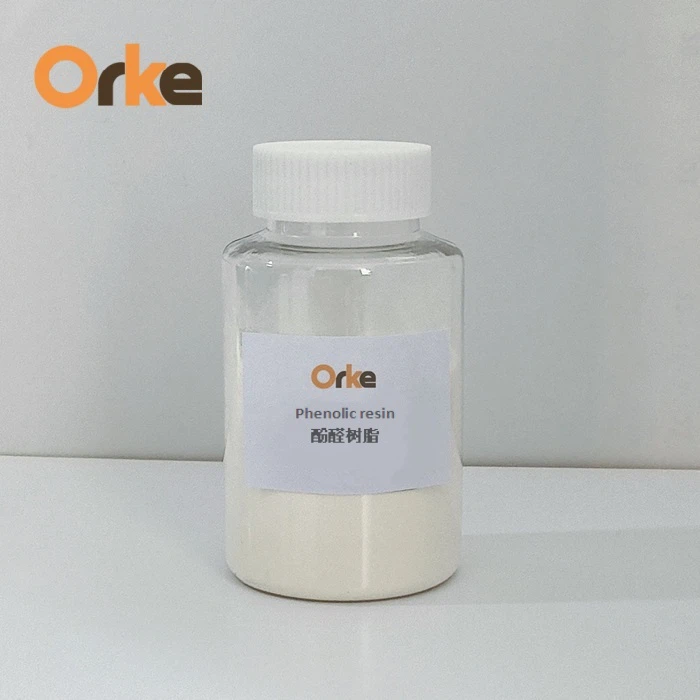

phenolic resin functions as a binder and fuel component in pyrotechnic star compositions, and its decomposition behavior and char-forming tendency influence the burn rate of the composition [1][2]. Published studies document that phenolic resin can suppress combustion rate in certain pyrotechnic systems compared to other binder chemistries [3][4]. However, burn time is determined by the complete formulation - oxidizer type and ratio, fuel particle size, binder loading, and consolidation - not by the resin alone [3][5]. There is no universal "burn time" that can be attributed to phenolic resin without specifying the full composition.
1. What Is Phenolic Resin in Fireworks?
Phenolic resin used in pyrotechnics is typically a novolac (two-step) Phenol Formaldehyde Resin, which requires a curing agent such as hexamethylenetetramine (HMTA) and heat to cross-link [1][6]. It functions simultaneously as a structural binder and a combustible fuel component [1][2]. A dedicated Phenolic Resin for Fireworks grade is specified for particle size, cure profile, and impurity limits compatible with pyrotechnic compositions.
2. How Phenolic Resin Influences Burn Rate
2.1 Decomposition and Char Formation
Phenolic resin is a char-forming polymer. During pyrolysis, the methylene bridges between aromatic rings break, releasing gases, while the aromatic structures condense into a carbon-rich char [1][8]. This char layer can act as a temporary barrier between the flame front and unburned composition, slowing the rate at which heat penetrates the star [2][3].
2.2 Published Combustion Data
| System | Observed Effect | Source |
|---|---|---|
| Ba(NO3)2/Mg with phenolic resin vs. nitrocellulose | Phenolic-bound system: peak burn temperature 1,594.5 degrees C, burn rate 12.5 mm/s; nitrocellulose-bound: 1,432.6 degrees C, 9.0 mm/s | Ouyang et al., Central European Journal of Energetic Materials, 2013 [4] |
| Black powder with phenol-formaldehyde resin addition | Phenolic resin addition suppresses combustion rate and enables stable long-duration burning | Miletic et al., Scientific Technical Review, 2023 [3] |
| KNO3-based pyrotechnic compositions | Phenol-formaldehyde resin used at 7–13% as fuel/binder; optimal at 10–11% | Saxena et al., Journal of ASTM International, 2023 [5] |
Important: these data show that phenolic resin can influence burn rate, but the direction and magnitude depend on the specific system. In the Ba(NO3)2/Mg system, phenolic resin produced a higher burn rate than nitrocellulose [4]; in black powder delay compositions, it suppressed the burn rate [3]. There is no universal "phenolic resin burn time." Documented binder loadings themselves vary by system - approximately 2.9 wt% in the EP 1127860 A1 example [7], approximately 5 wt% in black powder delay compositions [3], and 7–13% in KNO3-based fire-extinguishing formulations [5] - reinforcing that no single loading applies universally.
3. What Determines Burn Time in a Star
| Factor | Effect on Burn Time | Reference |
|---|---|---|
| Oxidizer-to-fuel ratio | Oxygen balance governs completeness of combustion and rate | [3][5] |
| Binder loading | Typical phenolic resin content is system-dependent: approximately 5 wt% in black powder delay compositions and 7–13% in KNO3-based fire-extinguishing formulations; excess binder can clog porosity and cause smoldering | [3][5] |
| Particle size of ingredients | Finer particles increase surface area and burn rate | [3] |
| Consolidation / density | Higher density reduces porosity and slows flame propagation | [2][3] |
| Resin cure degree and cross-link density | Affects char formation and thermal stability | [1][6][8] |
Key point: burn time cannot be adjusted by changing the resin alone. It is a system-level property requiring formulation-specific validation.
4. What This Article Does NOT Claim
- No specific burn time figures (e.g., "1.2 s to 3.8 s" or "4.2 s") attributed to phenolic resin alone. Burn time is formulation-specific [3][4][5].
- No claim that phenolic resin always slows burn rate. In the Ba(NO3)2/Mg system, phenolic-bound compositions burned faster than nitrocellulose-bound ones [4].
- No claim that "more resin = longer burn time." Excess binder can reduce porosity and cause incomplete combustion [3][5].
- No claim that pyrotechnic, electronic, composite, or oilfield grades are interchangeable. Grade differences in cure chemistry and impurity profile matter for burn behavior; see Electronic Grade Phenolic Resin for a distinct application grade.
- No specific customer case data or percentage performance improvements.
5. Quality Parameters to Request Before Evaluation
| Parameter | What to Request |
|---|---|
| Resin type | Novolac (with HMTA) or resole [1][6] |
| Recommended binder loading | Supplier guidance for the specific oxidizer/fuel system [3][5] |
| Thermal decomposition / char yield | Indicative of combustion contribution [1][6][8] |
| Particle size distribution | Dispersion and burn uniformity |
| Batch-specific COA | Confirms delivered batch values |
6. Regulatory Note
NFPA 1123 (2026) is the Code for Fireworks Display, covering the operation and site requirements for fireworks displays [9]. It is not a standard for pyrotechnic product composition or burn time. NFPA 1124 (2022) covers manufacture, transportation, and storage of fireworks and pyrotechnic articles [10]. Pyrotechnic composition manufacturing is a licensed activity under applicable regulations (e.g., ATF 27 CFR Part 555; OSHA 29 CFR 1910.109).
7. Conclusion
As the preceding sections show, phenolic resin functions simultaneously as a structural binder and a combustible fuel component in pyrotechnic star compositions, and its char-forming decomposition behavior influences burn rate - but the direction of that influence is system-dependent [1][2][3][4]. Published data document both outcomes: a faster burn than nitrocellulose in Ba(NO3)2/Mg compositions (1,594.5 degrees C, 12.5 mm/s vs. 1,432.6 degrees C, 9.0 mm/s) [4], and a suppressed burn rate in black powder delay compositions [3]. Binder loading is equally system-dependent - approximately 2.9 wt% in the EP 1127860 A1 example [7], approximately 5 wt% in black powder delay compositions [3], and 7–13% in KNO3-based fire-extinguishing formulations [5]. Burn time is a system-level property governed by oxidizer-to-fuel ratio, binder loading, particle size, consolidation, and cure degree [1][3][5][6][8]. Regulatory boundaries are explicit: NFPA 1123 covers display operations, not composition or burn time; NFPA 1124 covers manufacture, transportation, and storage [9][10]; manufacturing remains a licensed activity under ATF 27 CFR Part 555 and OSHA 29 CFR 1910.109. Every value in this article is a published figure or supplier-documented range; burn performance must be validated in the complete formulation by the licensed manufacturer.
8. Next Step
If you are a licensed pyrotechnics manufacturer evaluating Phenolic Resin for Fireworks, send us:
- Binder system (novolac/HMTA or other)
- Application (star composition, delay, structural element)
- Current binder and observed burn characteristics
- Target burn profile (qualitative or rate-based)
- Required documentation (TDS, COA, thermal data)
We will recommend a suitable grade and provide batch-specific property data for your evaluation. Note: burn performance must be validated in your complete formulation.
Request Phenolic Resin for Fireworks TDS and Sample →
References
- Orke Chemical. How Is Phenolic Resin Applied to Firework Compositions? Technical Blog. [Char formation, thermal decomposition, and binder function in stars; supplier-documented.]
- Orke Chemical. Can Phenolic Resin Replace Other Binders in Fireworks? Technical Blog. [Phenolic resin as binder and fuel; moisture resistance; comparison with dextrin, gum arabic, and sodium silicate; supplier-documented.]
- Miletic, M.; et al. "Research on Gas Producing Time Delay Pyrotechnic Compositions Based on Black Powder and Phenol-Formaldehyde Resin." Scientific Technical Review, 2023, 73(1): 8–12. DOI: 10.5937/str2301008M. [Phenolic resin addition suppresses combustion rate in black powder delay compositions; typical composition contains approximately 5 wt% phenol-formaldehyde resin.]
- Ouyang, D.; et al. "Effect of Different Binders on the Combustion Characteristics of Ba(NO3)2/Mg-containing Pyrotechnic Mixtures." Central European Journal of Energetic Materials, 2013, 10(2): 209–215. [As reported in the study: phenolic-bound system peak burn temperature 1,594.5 degrees C, burn rate 12.5 mm/s; nitrocellulose-bound 1,432.6 degrees C, 9.0 mm/s.]
- Saxena, A.; et al. "Potassium Nitrate Based Pyrotechnic Compositions as the Most Efficient Fire Extinguishing Agents." Journal of ASTM International, 2023. [Phenol-formaldehyde resin 7–13% w/w; optimal at 10–11% with KNO3 approximately 70%.]
- Milewski, B.; et al. "Interaction of Hexamethylenetetramine with Phenol–Formaldehyde Resin during Simultaneous Curing of Novolac and Resole." ACS Omega, 2026, 11(18): 26206–26219. [Novolac requires HMTA and heat for cross-linking.]
- European Patent EP 1127860 A1. Pyrotechnic Composition and Method for Preparation Thereof. [Example 1: nitrocellulose/nitroalkane gel binder invention; phenolic resin (RESITOP™ PGA-2400, Gun-ei Chemical Industrial Co. Ltd.) appears as one of several organic fuel components at 2.4 parts of approximately 84 total parts (approximately 2.9 wt%), alongside potassium perchlorate, hemp coal, VINZOL™, chlorinated rubber, and copper oxide; dried at 50–60 degrees C.]
- Knop, A.; Pilato, L. A. Phenolic Resins: Chemistry, Applications and Performance. Springer, Berlin, 1985 (reprinted 2013). [Char formation and thermal degradation of phenolic networks.]
- NFPA 1123 (2026). Code for Fireworks Display. National Fire Protection Association. [Covers fireworks display operations and site requirements; does not specify composition or burn time.]
- NFPA 1124 (2022). Code for the Manufacture, Transportation, and Storage of Fireworks and Pyrotechnic Articles. National Fire Protection Association. [Covers manufacture, transportation, and storage; distinct from NFPA 1123 display scope.]